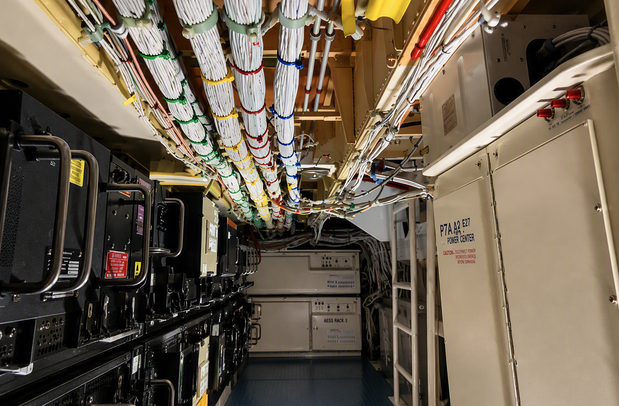
When you’re next sitting aboard a plane, consider the fact that there are many dozens or even hundreds of miles of electrical wiring on board, controlling the aircraft and feeding the technology around you. Fly-by-wire controls, avionics (electronic systems used on aircraft), reading lights, air conditioning and entertainment screens, as well as galley equipment and safety features - those miles of wiring interconnect to link everything back to the cockpit and cabin controls.
Now imagine you’re the electrical engineer working on that wiring – how do you distinguish between one wire and another, when some of it can be as narrow as 0.8mm in diameter with insulation about 3 times the diameter of a human hair?
Dr Peter Dickinson of Spectrum Technologies tells us how his business has commercialised innovative ways of marking identity codes on wires that are not only used across the world but are even circling us in space!

From solving a problem to creating a global standard
Spectrum Technologies was established in 1989 as a spin-out from British Aerospace (now BAE Systems). Spectrum’s founder member Dr Peter Dickinson was leading a programme in industrial laser technology at the company's research centre in Filton, Bristol.
At the time, the aerospace industry faced a growing challenge: aircraft wiring had traditionally been identified with alphanumeric codes using an ink-based impact marking process called hot stamping, a technique dating back to 1941. However, over the decades, aircraft electrical wiring interconnect systems (EWIS) grew in size and complexity, also growing in weight; the EWIS on a large jetliner now weighs in at several tonnes.
The ever-present need to minimise aircraft weight drove the requirement for lighter wiring, resulting in the insulation becoming much thinner and increasingly made from advanced non-stick materials, making it prone to damage. The old marking methods struggled to keep up and, in some cases, did damage the wiring itself.
Working with Airbus and other aerospace partners, Peter's team investigated alternative technologies and made a breakthrough using ultraviolet lasers. Unlike conventional laser processes that burn material away, the UV laser created a permanent mark by changing the colour of pigments within the insulation itself.
"We established that it was effectively the equivalent of a permanent suntan," says Peter. "We were changing the colour of a pigment embedded in the insulation without damaging the wire."
Recognising the commercial potential, British Aerospace tasked Peter with bringing the technology to market, leading to the creation of Spectrum Technologies.
What does this technology look like today?
Today, Spectrum Technologies’ ultraviolet laser wire-marking technology has become the global aerospace industry standard. Spectrum designs and manufactures the highly specialised laser-based systems used to mark, identify, strip and process wire and cable assemblies. Its headquarters in Bridgend is supported by teams across the world, doing business in Europe, North America, Asia, the Middle East, Africa, South America and Australia.
The company's systems are used by virtually every major aerospace manufacturer, including Boeing, Airbus, Lockheed Martin, SpaceX and BAE Systems. The technology may be unseen by airline passengers, but it plays a critical role in aviation. Individual wires must be uniquely identified to enable efficient manufacture, maintenance and repair throughout the aircraft's lifetime.
"At any given moment, around 1.5 million miles of laser-marked wiring is flying around the world on 12,000-15,000 aircraft" says Peter.
Some 'plane' facts
- 150 miles of electrical wiring in one Boeing 777, and 185 miles in a Boeing 747, requiring around one million identification codes to be marked
- up to 60,000 individual wires in a large commercial aircraft requiring identification
- 50,000 tonnes of emissions estimated as saved annually across the global aviation fleet by eliminating the need for thick identification sleeves on aircraft cables
- 1.5 million miles of laser-marked wiring in the air at any given moment.
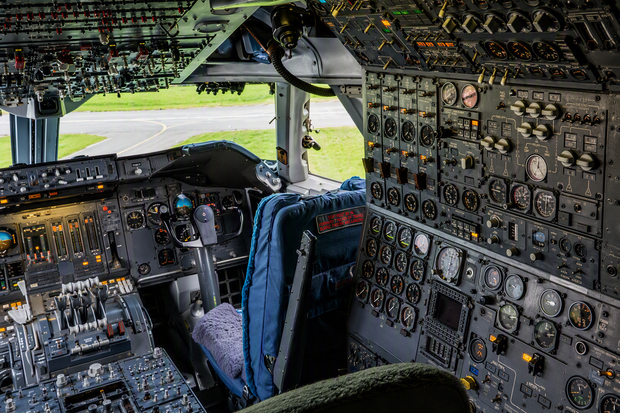
Spectrum’s technology is also used on military platforms, satellites, medical devices, consumer electronics and space missions.
“Our laser wire marking is used primarily for aerospace and some rail and defence electrical wiring interconnection systems (EWIS ) applications, whereas our laser wire stripping is used foremost in the electronics and medical sectors”, Peter told us.
Spectrum in space - technology used on Moon and Mars missions and beyond
Spectrum equipment has been used to produce wiring for:
- NASA's Artemis programme and Orion spacecraft
- NASA's Mars InSight lander
- NASA's Lucy mission, currently travelling towards asteroids near Jupiter.
As Peter puts it: "Pretty much anything flying today that's been built in the last 20-30 years will have wiring identified using the technology we developed."
How has IP helped commercialise the technology?
Intellectual property (IP) protection has been central to Spectrum's commercial success. Spectrum has worked with IP specialists, patent attorneys Wynne-Jones IP since the early 1990s and values their guidance in assessing patentability, drafting applications and developing international filing strategies. Peter believes patents were particularly valuable in the company's formative years:
"If you get the patent right, then you've got a very good level of protection, which creates high barriers to new entrants".
Over the years, Spectrum has successfully protected its technology and, in one case, negotiated a licence agreement after identifying a competitor using patented technology in the UK market. Peter is quick to point out that obtaining effective patent protection requires careful preparation, however.
"There is a lot of pre-existing technology out there," he says. "It's important to make sure you've got something that is genuinely patentable and that the patent is written in the right way".
Spectrum Technologies facts and figures
- 65 countries worldwide have bought Spectrum products and services
- 2,500 Spectrum laser systems supplied and installed globally
- 93% of what Spectrum manufactures (that’s more than £200 million-worth of equipment and services over time) has been exported
- 4 King's and Queen's Awards:
- Queen's Award for Enterprise (1995)
- Queen's Award for Enterprise (2000)
- Queen's Award for Enterprise (2006)
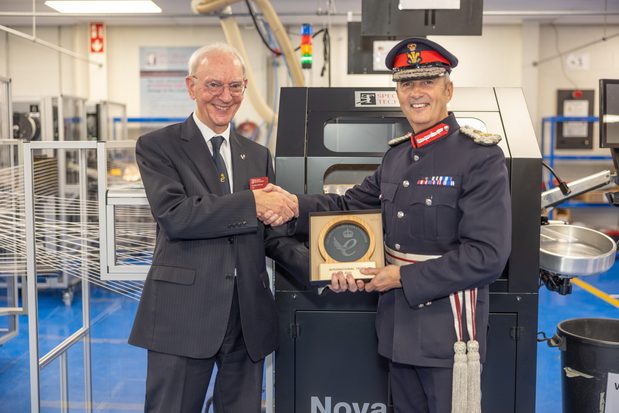
- King's Award for Enterprise in International Trade (2025).
What patents does Spectrum hold?
Over the years, Spectrum has held a number of patents covering various aspects of its technology and equipment. Notable examples include:
- UK patent GB2553309 relating to wire control technology used in the company's Nova 800i series machines. The patent remains in force until 2036
- US Patent US6144011A and European Patent EP0882271A1 covering technology used to synchronise laser operation and character positioning to improve marking quality
- US Patent US6826307B1 and European Patent EP0925549A1, covering a quality assurance system used to measure mark contrast and verify marking performance.
What would you say to technology businesses starting today?
Peter's advice is straightforward:
"If you've got something that is truly novel and has commercial value, then absolutely look at patenting it."
He is keen to stress the importance of identifying the core innovation, undertaking thorough prior-art searches and working with experienced patent attorneys. Peter’s message to innovators is simple:
"Protect valuable technology early and ensure the protection focuses on the real invention at the heart of the product."
What's next for Spectrum Technologies?
The company is expanding its automation capabilities, developing new systems and working on laser marking solutions for highly specialised medical applications, surgical instruments and medical devices.
So, where can Spectrum possibly go after becoming the global aerospace standard and circling space? With a smile, Peter offers his answer:
“First global domination, then the solar system, and after that, perhaps the galaxy!”
For a South Wales business whose technology is already helping power some of humanity's most ambitious engineering achievements, it may not be quite as fanciful as it sounds.
Spectrum Technologies is a long-established business that has a firm hold on its intellectual property and the part it plays in the business. For those starting out at the beginning of the process, there is free help available in our free guide, Get intellectual property rights: step-by-step - GOV.UK
Leave a comment