It's Halloween, so the fleeting worry of being buried alive may have crossed your mind – though a few centuries ago, you would have had far greater reason to be concerned. With limited medical knowledge and no safeguards to protect the unfortunate soul, premature burial was a very real possibility.
There are accounts from as early as the 14th century of people being buried alive. One medieval tale tells how Philosopher John Duns Scotus was found outside his coffin with horrifying wounds to his hands, suggesting he had clawed his way out. Though the reliability of the story is doubtful, there have been others….

Alice Blunden managed it twice! The blood curdling tale took place in 17th century Basingstoke where Alice fell unconscious after drinking a large amount of poppy tea. The tea made from dried, unwashed seed pods would have contained the powerful sedatives morphine and codeine.
Her family were unable to revive her whilst a doctor, after holding a mirror to her nose and mouth, pronounced her dead. She was quickly buried but two days after this, children playing near the grave heard muffled noises and screams. Their schoolmaster, not believing the children, delayed investigation for a day and once he suspected Alice was still alive, it took another day to exhume her.
In a dark turn, after exhuming Alice her family decided she was so close to death, that she should be returned to her grave. According to the Basingstoke gazette, ‘The next morning on opening the coffin once more, it was discovered that Mrs Blunden had woke, torn her grave clothes, scratched at her body and face, and was covered in blood. And overnight she had died.’
These horrifying real-life accounts didn't just haunt families—they captured the imagination of writers and inventors alike.
Stoking the fear
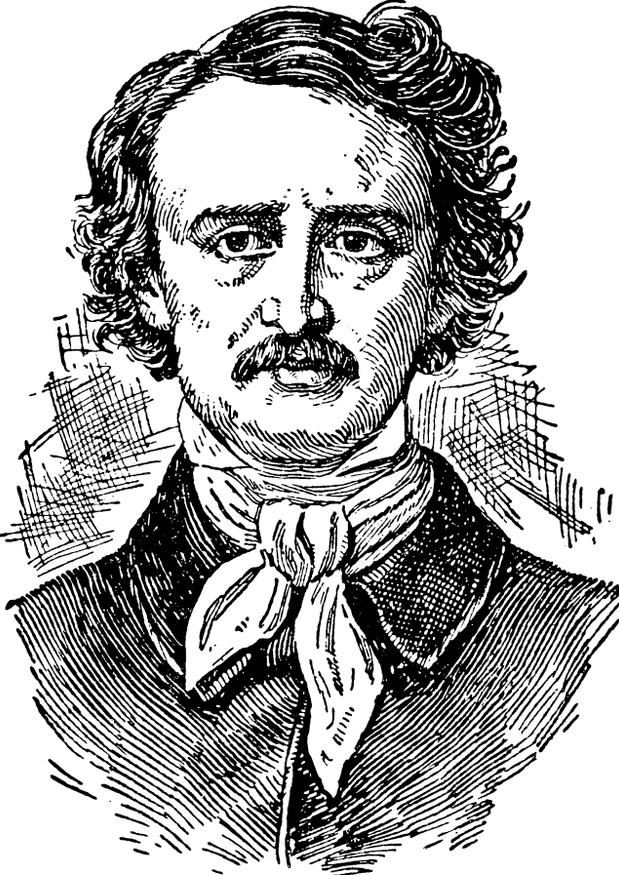
Writers capitalised on people’s fears with stories like Edgar Allan Poe's 1844 "Premature Burial," where the narrator, consumed by fear of being buried alive, takes extreme precautions in modifying his tomb:
“This coffin was warmly and softly padded, and was provided with a lid, fashioned upon the principle of the vault-door, with the addition of springs so contrived that the feeblest movement of the body would be sufficient to set it at liberty. Besides all this, there was suspended from the roof of the tomb, a large bell, the rope of which, it was designed, should extend through a hole in the coffin, and so be fastened to one of the hands of the corpse.”
Whether Poe inspired future innovation remains unclear, but his story did precede a creepy category of invention – the coffin alarm.
Coffin Alarms
Coffin alarms were a series of inventions designed to aid someone, who was buried alive, to escape, breathe and signal for help.
US Patent 81437A , Franz Vester, 1868, for an “Improved Burial-Case”
The patent shows a few features designed to prevent the worst from occuring. An air inlet, ladder and a bell to ring in case the unfortunate person was too weak to climb the ladder.
Patent US268693, John Krichbaum,1882, for a “Device for Indicating Life in Buried Persons”
The device includes two key features: a way to signal movement from inside the coffin and a method for allowing fresh air in. According to the description, if the buried person regains consciousness, they can move their hands to rotate the branches of a T-shaped pipe positioned near them. This movement is visible on an above-ground box, indicating activity inside. Meanwhile, the pipe also allows air to flow passively into the coffin. Once enough time has passed to confirm the person is truly deceased, the device can be removed.
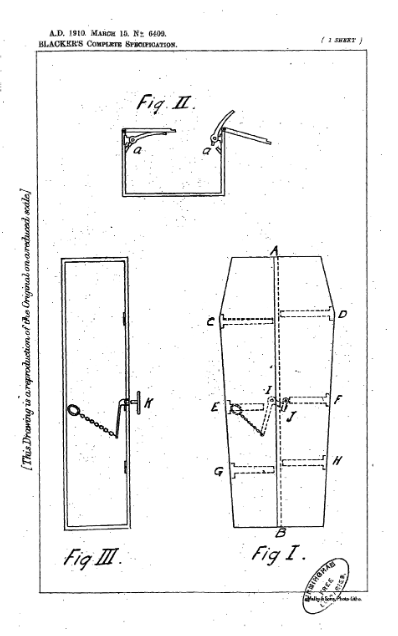
GB191006409A, Emily Violet Blacker, 1911, An Improved Life-saving Coffin whereby the Danger Attending Premature Burial can be Entirely Obviated
This Edwardian safety coffin was designed to prevent premature burial. Before the grave was finally filled in, the coffin was placed in the grave and left accessible. It features a spring-loaded lid connected to the deceased's hands via chains and rings attached to a catch mechanism. If the person revives and makes even the slightest hand movement—such as clenching their fists—this releases the catch and triggers powerful springs that force the lid open, even through up to six inches of covering earth or deodorising material. The coffin is made deeper than usual to allow hand movement and can only be locked from outside with a special key. An optional tube with litmus paper could signal when decomposition had begun. This mechanism would allow the final burying of the coffin to take place once there was no longer any doubt about the person’s condition.
Comfort to the living
With the advance of modern medicine, we can measure brain waves, heartbeat and respiration, so determining whether someone is dead or alive has become more exact. That doesn’t mean the inventions have stopped. They’ve just become more about the experience of death and offering comfort to the living.
Take US patent 9226059B1 granted in 2015 to inventor John Knight for ‘Your music for eternity systems’. The system comprises a solar powered digital music player, which allows both the living as well as the dearly departed to be comforted by music or a recorded message. There is a speaker in the casket and a headset jack on the headstone so you can visit your dead relatives and reminisce with meaningful music.
Similarly US Patent 7765656, granted in 2010 to inventor Jeff Dannenberg for an “Apparatus and Method for Generating Post-Burial Audio Communications in a Burial Casket”. This allows the living to communicate with the dead through audio and music files that are automatically played in accordance with a programmed schedule.
Lessons from the Grave
So, there you have it: from Victorian escape mechanisms to solar-powered sound systems, death has proved surprisingly good for intellectual property. Happy Halloween—and remember, if you're planning your eternal rest, don't forget to include your playlist.
Leave a comment